
You’re ready to level up your milling work, but choosing the right dividing head can feel overwhelming. Whether you’re cutting gears or complex angles, the wrong choice wastes time and material. Let’s cut through the noise. These nine heads cover everything from compact hobbyist units to heavy duty professional models. But first, you need to know what actually matters for your machine.
| ZHIMAI 6 Inch Precision Dividing Head Set | 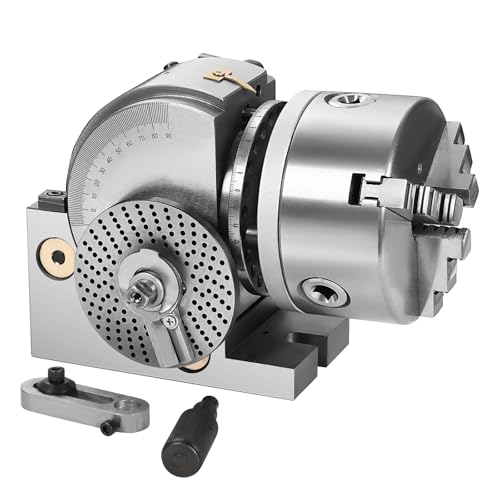 | Best for Heavy Duty | Center Height: 5/128 inches | Chuck Size: 6-inch 3-jaw chuck | Worm Gear Ratio: 1:40 | VIEW LATEST PRICE | Read Our Analysis |
| Vevor 5″ 3-Jaw Chuck Dividing Head |  | Best Value | Center Height: Not specified | Chuck Size: 5-inch 3-jaw chuck | Worm Gear Ratio: Not specified | VIEW LATEST PRICE | Read Our Analysis |
| Universal Dividing Head For Milling Machine 8?128mm Center Height |  | Most Versatile | Center Height: 128mm | Chuck Size: Not specified | Worm Gear Ratio: 1:40 | VIEW LATEST PRICE | Read Our Analysis |
| Universal Dividing Head for Milling Machine 6? 128mm Center Height |  | Professional Grade | Center Height: 128mm | Chuck Size: Not specified | Worm Gear Ratio: 1:40 | VIEW LATEST PRICE | Read Our Analysis |
| KAKA Industrial Dividing Head 5-Inch 3-Jaw Chuck |  | Complete Kit | Center Height: Not specified | Chuck Size: 5-inch 3-jaw chuck | Worm Gear Ratio: 40:1 | VIEW LATEST PRICE | Read Our Analysis |
| Vevor BS-1 Dividing Head Set with Chuck |  | Top Precision | Center Height: 5/128 inches | Chuck Size: 6-inch 3-jaw chuck | Worm Gear Ratio: 1:40 | VIEW LATEST PRICE | Read Our Analysis |
| Indexing head vertical and horizontal milling machine small indexer(1) |  | Compact Pick | Center Height: Not specified | Chuck Size: Available 5-inch or 6-inch (optional chuck) | Worm Gear Ratio: Not specified | VIEW LATEST PRICE | Read Our Analysis |
| Dividing Head 4″ with 3-Jaw Chuck |  | Best for Hobbyists | Center Height: Not specified | Chuck Size: 4-inch 3-jaw chuck | Worm Gear Ratio: 1:40 | VIEW LATEST PRICE | Read Our Analysis |
| Milling Machine 6-Inch Indexing Head with Chuck |  | Best Entry-Level | Center Height: Not specified | Chuck Size: 6-inch (includes BS-5 inch 125mm 3-jaw chuck) | Worm Gear Ratio: Not specified | VIEW LATEST PRICE | Read Our Analysis |
More Details on Our Top Picks
ZHIMAI 6 Inch Precision Dividing Head Set
You need a dividing head built to handle the heaviest workloads without flexing. That’s exactly what the ZHIMAI 6 Inch Precision Dividing Head Set delivers. Made from HT200 material, it’s rock-solid for demanding machining tasks.
You get a 1:40 reduction ratio for high-precision rotation with minimal rebound. The index head offers 24 quick division holes, so you can efficiently divide in multiples of 2, 3, 4, 6, 8, 12, and 24. One full rotation equals 360 degrees, with a 1-degree scale for accurate measurement.
Its semi-universal headstock tilts from 10° horizontally to 90° vertically, letting you work at versatile angles. And the 3-jaw chuck handles spindle speeds up to 2500 RPM. With a 6-1/2 inch swing, it’s compatible with your mill, drill, or grinder. Perfect for heavy duty precision work!
- Center Height:5/128 inches
- Chuck Size:6-inch 3-jaw chuck
- Worm Gear Ratio:1:40
- Tilt Range:10° below horizontal to 90° vertical
- Tailstock Included:Not specified
- Material/Construction:HT200 cast iron
- Additional Feature:24 quick division holes
- Additional Feature:Spindle speed up to 2500 RPM
- Additional Feature:Adjustable 10° to 90° tilt
Vevor 5″ 3-Jaw Chuck Dividing Head
This Vevor dividing head offers solid precision without a premium price. You get a durable stainless steel build with a mirror finish that resists wear. The headstock tilts from 10° below horizontal to 90° vertical, so you can handle different material sizes easily. Use the direct indexing plate and interchangeable plates with varying hole counts for accurate cutting distances. And you’ll get a tailstock for long workpiece support. It fits milling machines with an M38×3 thread size. Use it on drill presses, grinders, or boring machines. It’s versatile, sturdy, and a great value.
- Center Height:Not specified
- Chuck Size:5-inch 3-jaw chuck
- Worm Gear Ratio:Not specified
- Tilt Range:10° below horizontal to 90° vertical
- Tailstock Included:Yes
- Material/Construction:Stainless steel
- Additional Feature:Mirror finish construction
- Additional Feature:Interchangeable dividing plates
- Additional Feature:Thread size M38×3
Universal Dividing Head For Milling Machine 8?128mm Center Height
The Universal Dividing Head with an 8–128mm center height is the most versatile choice for mill owners tackling complex gear cutting and spiral work. You can precisely divide workpieces into equal parts, both circularly and linearly. This head clips workpieces at any angle—vertical, horizontal, or tilted—and its spindle rotates 90° upward, 10° downward. It handles helical gears, Archimedean spirals, and cam machining with ease.
- Center height: 128mm
- Worm gear ratio: 1:40
- Indexing plates: A (15-20 holes), B (21-33), C (37-49)
- Construction: Durable carbide and cobalt
Its dividing scale ring, vernier, and switch gear ensure precise positioning with minimal backlash. Need high accuracy for arbitrary circumferential division? This head delivers, and it’s backed by a 30-day return policy. No fluff, just solid performance.
- Center Height:128mm
- Chuck Size:Not specified
- Worm Gear Ratio:1:40
- Tilt Range:10° downward to 90° upward
- Tailstock Included:Not specified
- Material/Construction:Carbide and cobalt
- Additional Feature:Processes helical gears and cams
- Additional Feature:Three indexing plates (A, B, C)
- Additional Feature:Carbide and cobalt materials
Universal Dividing Head for Milling Machine 6? 128mm Center Height
Designed for serious machinists, the Universal Dividing Head (6-inch, 128mm center height) offers professional grade precision with minimal backlash. You’ll appreciate the strong structure and fine appearance. It divides workpieces into equal parts both circularly and linearly, and you can clip them at vertical, horizontal, or tilt angles. The spindle rotates 90° upward and 10° downward.
Here’s the breakdown:
- Gear ratio: 1:40, letting you index precisely.
- Indexing plates: A (15-20 holes), B (21-33), C (37-49).
- Height: 320mm vertical, 220mm horizontal.
Use it for helical gears, grooves, or Archimedes spiral cams. It’s unfinished carbide but built for durability.
- Center Height:128mm
- Chuck Size:Not specified
- Worm Gear Ratio:1:40
- Tilt Range:10° downward to 90° upward
- Tailstock Included:Not specified
- Material/Construction:Carbide and cobalt
- Additional Feature:Processes Archimedes spiral cams
- Additional Feature:Three indexing plates (A, B, C)
- Additional Feature:Carbide and cobalt materials
KAKA Industrial Dividing Head 5-Inch 3-Jaw Chuck
You want a head start with a complete kit that doesn’t require extra shopping? This KAKA Industrial 5 inch model delivers just that. It includes the BS-0 dividing head, a 3 jaw chuck, MT2 tailstock, centers, driving dog, threaded back plate, and three dividing plates.
You’ll appreciate the 40:1 worm gear ratio for accuracy on gears, faces, or flutes. Need angled machining? The head tilts from 10° below horizontal to 90° vertical.
It supports direct indexing with a 24 hole pattern for quick divisions like 2, 3, 4, 6, 8, 12, and 24. Indirect indexing uses plates A, B, and C, covering 2 to 380 divisions (excluding primes). That robust MT2 tailstock stabilizes long workpieces perfectly.
- Center Height:Not specified
- Chuck Size:5-inch 3-jaw chuck
- Worm Gear Ratio:40:1
- Tilt Range:10° below horizontal to 90° vertical
- Tailstock Included:Yes (MT2)
- Material/Construction:High-quality metal with mirror finish
- Additional Feature:40:1 worm gear ratio
- Additional Feature:Thread size 1/2-20 UNC
- Additional Feature:Three dividing plates included
Vevor BS-1 Dividing Head Set with Chuck
Looking for a semi universal dividing head that balances solid build quality with sharp value? The Vevor BS-1 set delivers just that. It’s a semi universal model built from HT200 cast iron, so you get a rigid frame with minimal backlash. You’ll appreciate the 1:40 reduction ratio and laser engraved scales for precise positioning.
- Includes: 6” three jaw chuck, tailstock, dead center, and three index plates
- Adjustability: Headstock tilts from horizontal to 90 degrees upward
- Speed: Handles up to 2,500 RPM
You can handle indirect dividing from 2 to 380 divisions, skipping only primes and specific values. It’s a solid, versatile buy for your milling setup.
- Center Height:5/128 inches
- Chuck Size:6-inch 3-jaw chuck
- Worm Gear Ratio:1:40
- Tilt Range:Horizontal to 90° upward
- Tailstock Included:Yes (MT3)
- Material/Construction:HT200 cast iron
- Additional Feature:Laser-engraved scales
- Additional Feature:Spindle speed up to 2500 RPM
- Additional Feature:Through-hole diameter 20 mm
Indexing head vertical and horizontal milling machine small indexer(1)
Ever wonder how to get precise indexing without a bulky setup? This small indexer delivers, with a rigid, mirror finished surface that resists wear. You’ll find its delicate, precisely working parts make dividing materials a breeze. For accuracy, you get a direct plate plus two interchangeable replacements, each with different hole counts. That means you can set cutting intervals exactly. It supports long metallic workpieces, reducing movement for stable machining. Use it on a mill, drill press, grinder, or boring machine. Available in 5 inch and 6 inch models, with chuck options. And you can add a quick or standard tailstock as needed.
- Center Height:Not specified
- Chuck Size:Available 5-inch or 6-inch (optional chuck)
- Worm Gear Ratio:Not specified
- Tilt Range:Not specified
- Tailstock Included:Optional (quick, standard, or 8-inch)
- Material/Construction:Rigid mirror-finished metal
- Additional Feature:Mirror-finished surface
- Additional Feature:Direct and interchangeable plates
- Additional Feature:JUNIVEX brand
Dividing Head 4″ with 3-Jaw Chuck
This 4 inch dividing head with a 3 jaw chuck is a strong pick for hobbyists who want professional level results without the pro price tag. You get a semi-universal set including the chuck, tailstock, and three dividing plates, which handle precise indexing jobs like a champ. It’s built tough, with a 1:40 gear ratio and flexible angle adjustment from 10 to 90 degrees. So you can tackle vertical, horizontal, or inclined machining. The MT2 tailstock keeps your long workpieces stable. Perfect for automotive or mold work, plus woodworking. Just clamp, rotate, and cut with confidence.
- Center Height:Not specified
- Chuck Size:4-inch 3-jaw chuck
- Worm Gear Ratio:1:40
- Tilt Range:-10° to 90°
- Tailstock Included:Yes (MT2)
- Material/Construction:Robust universal head standards
- Additional Feature:Three 4-jaw chucks included
- Additional Feature:Honeycomb plate compatibility
- Additional Feature:Furvveerr brand
Milling Machine 6-Inch Indexing Head with Chuck
For someone stepping into precision milling, the Milling Machine Universal 6-inch Indexing Head with Chuck offers an entry point that balances simplicity with dependability. You get a compact manual device with a high-hardness, wear-resistant surface that shrugs off scratches and abrasion. It works vertically or horizontally on milling, grinding, drilling, or planing machines. The direct indexing plate plus two interchangeable plates let you set cutting distances accurately. You’ll find it ideal for simple slitting tasks. And at about 22 pounds, it’s solid without being a backbreaker. Just mount your 125 three-jaw chuck, dial in your rotation, and you’re ready for precise, repeatable cuts.
- Center Height:Not specified
- Chuck Size:6-inch (includes BS-5 inch 125mm 3-jaw chuck)
- Worm Gear Ratio:Not specified
- Tilt Range:Not specified
- Tailstock Included:Not specified
- Material/Construction:High-hardness wear-resistant surface
- Additional Feature:High-hardness wear-resistant surface
- Additional Feature:125 three-jaw chuck included
- Additional Feature:Model BS-5 inch
Factors to Consider When Choosing a Dividing Head for Mill
Before you buy, you’ll need to match three key specs to your mill: size and capacity, center height, and reduction ratio. Don’t forget indexing plate options and tilt range adjustment, as these determine which complex cuts you can actually pull off. Getting these right from the start saves you from costly mismatches and frustrating workarounds later!
Size and Capacity
When you’re choosing a dividing head for your mill, two critical factors are its size and capacity. Size is measured by swing diameter, which tells you the maximum workpiece diameter you can handle. Don’t overshoot or undershoot here. Match the capacity to your largest project, ensuring it won’t overload the head. Larger heads offer more versatility, but they’re heavier and pricier to run. That’s a tradeoff you’ll need to weigh.
Now, capacity isn’t just about workpiece size. It must align with your machine’s spindle size and mounting options. Check compatibility upfront. For example, a 6-inch swing head suits small jobs, while a 10-inch swing handles bigger parts. Pick one that fits your typical projects, not just your dream ones. A mismatch here causes headaches, so measure twice and buy once.
Center Height
Center height is the vertical distance from your milling machine’s table to the spindle’s centerline, and you need your dividing head to match that exact measurement. Get this wrong, and you’ll face workpiece clearance issues, plus vibration that ruins your cuts. Standard center heights range from 8mm to 128mm, so check your machine’s specs first.
A higher center height lets you handle larger workpieces, but you’ll need extra space and stability. Don’t just grab the biggest one available. Match it precisely to your mill’s spindle height, and you’ll minimize inaccuracies during division. That alignment keeps everything rigid and smooth.
Reduction Ratio
The reduction ratio is your dividing head’s core spec for precision, and it’s often a fixed number like 1:40 or 1:60. This ratio dictates how many turns of the handle rotate the spindle once. So, a 1:40 ratio means you need 40 handle turns for one full spindle rotation, giving you finer control over divisions. That’s essential for complex tasks like cutting gears or flutes. Higher ratios, like 1:60, let you split a circle into more segments, so you’ll nail non-prime divisions with ease. But remember, a higher ratio demands more torque from your mill; you might need extra power to keep things smooth. Always match the ratio to your typical work. If you’re often dividing into 40 or 60 steps, a 1:40 head is your best friend. It’s straightforward and efficient, no guesswork needed.
Indexing Plate Options
Reduction ratio tunes your precision, but indexing plates are where flexibility really shines. You’ll find plates with hole counts like 15-20, 21-33, 37-49, or 24-hole patterns, each enabling unique division possibilities. Interchangeable plates support both direct and indirect indexing, letting you tackle complex tasks like gears, helical cuts, and spiral patterns without breaking stride.
When you choose a dividing head, verify the included plates cover your specific needs. Are you machining simple parts or precise multi-part divisions? Some heads offer a mix of fixed and removable plates, broadening your range. That’s a real game changer for versatility. So, look for a set that gives you the options you’ll actually use. It’s not just about the holes; it’s about the work you can accomplish.
Tilt Range Adjustment
How much angle can you actually dial in? That’s the big question. The tilt range adjustment directly controls how you position workpieces for accurate machining. You want a dividing head that swings from 10° horizontally to 90° vertically. That versatile range gives you serious operation angles for tasks like gear cutting, helical features, or tapered components.
Plus, an adjustable tilt feature lets you lock in precise angles, which improves accuracy on complex jobs. Think about it: you’re machining at various slopes for angled drilling or grooving. A wider tilt range means greater flexibility when you need non-vertical or inclined positions. Don’t settle for a limited headstock.
Instead, look for a tilt range that covers both shallow and steep angles. This way, you’ll handle everything from subtle tapers to deep helical cuts without swapping setups. It’s a simple factor, but it’ll save you headaches down the line.
Material and Build
Once you’ve sorted out the tilt range you need, it’s time to look at what the head is actually made of. The material, like HT200 cast iron or stainless steel, dictates your head’s durability and wear resistance. You want a robust build with high-grade materials because that reduces backlash and keeps your division operations precise. Thicker, stronger structures handle large workpieces without deforming, no matter how heavy the load gets.
Don’t overlook the finishing either. A mirror polish resists wear and is a breeze to maintain, while unfinished surfaces can trap grime and corrode faster. And if your shop is humid, choose a corrosion-resistant material to extend the head’s life. Here’s a quick checklist:
- Look for HT200 or better for heavy duty use.
- Prioritize thick, rigid construction for stability.
- Opt for smooth finishes on critical surfaces.
That build quality directly impacts your accuracy and longevity, so don’t skimp here.
Spindle Compatibility
You’ve got a solid build in mind, but now it’s time to make certain the dividing head actually talks to your mill. Spindle compatibility isn’t optional, it’s the whole conversation. First, check the spindle size and thread type. Your mill’s spindle and the dividing head’s spindle must share the same language, otherwise nothing fits.
Then, verify the maximum rotation speed. Overloading it is a recipe for chatter or worse. You’ll also need to confirm the mounting and locking mechanisms. A loose head isn’t a happy head. Make sure the spindle’s length and diameter suit your workpiece and accessories. Finally, confirm it supports the angular adjustments and tilting capabilities you need. Get these details right, and your dividing head will be a seamless extension of your milling setup.
Tailstock Support
Why would you leave a long workpiece unsupported and risk chatter, deflection, or worse, a ruined part? A tailstock isn’t optional for serious mill work; it’s essential for stability and accuracy. Look for an adjustable model with a tilting range from 10° below horizontal to 90° vertical, so you can tackle different machining angles. A heavy-duty, ball-bearing tailstock minimizes backlash, giving you smooth rotation and precise positioning. Make sure it fits your dividing head’s spindle size, like MT2 or MT3, to hold workpieces securely. When you pair a tailstock with your dividing head, you support the part along its length, reducing vibration and deflection. That means cleaner cuts, longer tool life, and parts that match your blueprint exactly. Don’t skip this.